01
Care
Free or subsidised treatment, casts, braces and rehabilitation for children whose families cannot carry the cost — and the quiet logistics that decide whether a child actually returns for the next cast: travel, food, a place to stay.
About SPANDA
SPANDA — the Scoliosis, Paediatric Orthopaedic and Neuromuscular Deformity Alliance — is a public charitable trust registered in Palakkad, Kerala, in September 2026.
The name comes from spanda: the pulse, the throb, the first stir of movement. It is what a parent feels before anything else, and what every child we meet is trying to do — move, stand, walk, play.
Children's bone, spine and nerve problems are different from adult orthopaedics. A growing skeleton remodels itself, a foot corrected in the first weeks of life can stay straight for eighty years, and a curve found early may never need an operation. But that only happens when someone recognises the problem, and when the family can reach the right hands in time.
SPANDA exists for those two gaps: recognition and reach. We educate the people who see the child first, train the clinicians who treat them, and help families for whom the cost of care is the deciding factor.
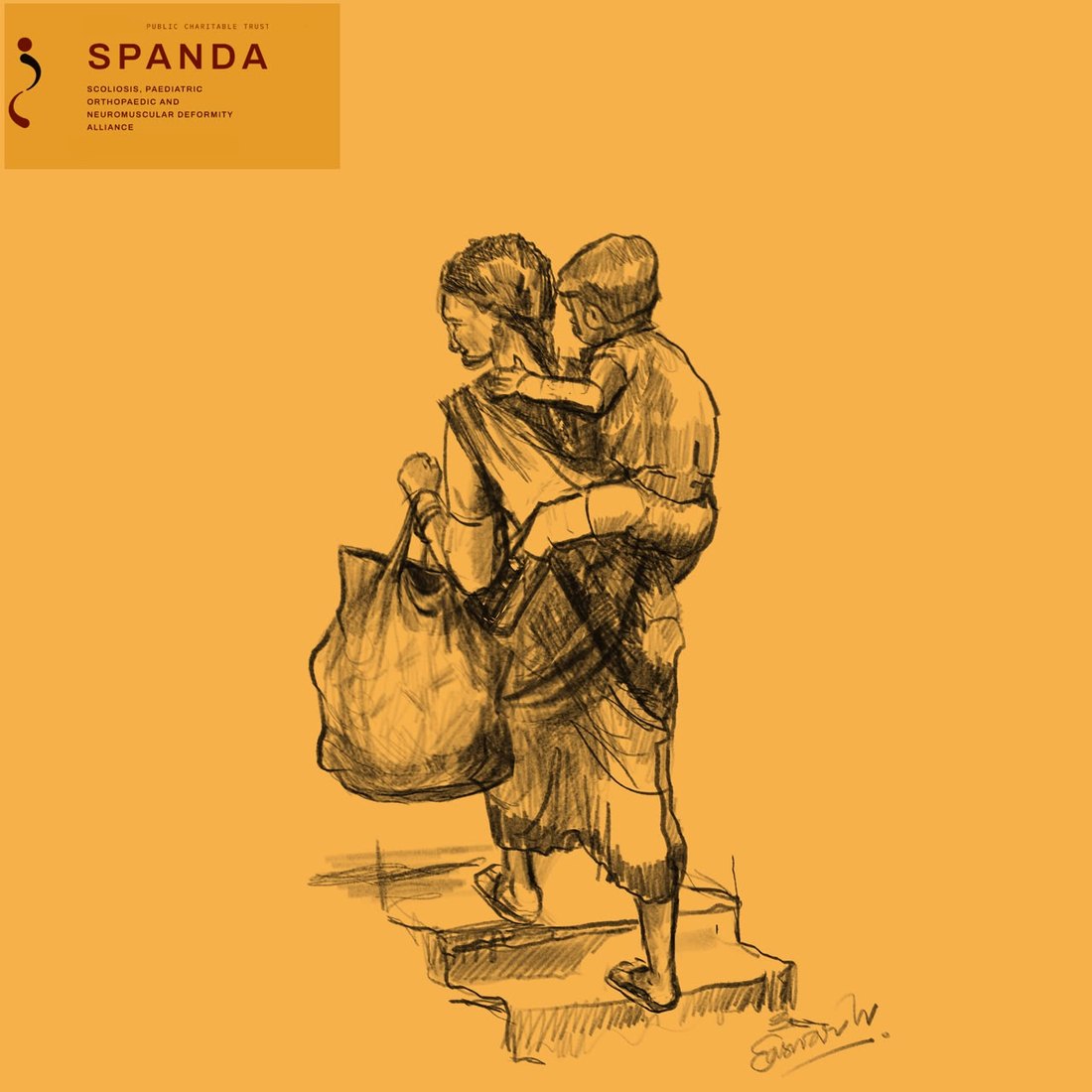
The journey a family makes — drawn for SPANDA by Dr. Easwar.
Charitable objects
The trust exists for children with deformities of the limb or the spine — scoliosis, clubfoot, limb length difference, bowed legs — for children with cerebral palsy and neuromuscular disease, and for the paediatric orthopaedic work that holds all of it together. These are the purposes it is legally bound to serve; every camp, course, brace or bus fare has to sit inside one of them.
To advance medical education and structured training in paediatric orthopaedics and allied disciplines — including paediatric spinal and limb deformity, musculoskeletal trauma, neuromuscular disorders, cerebral palsy and clubfoot — through courses, lectures, workshops, conferences, symposia, simulation and lawfully conducted cadaveric teaching, fellowships and observerships.
To train postgraduate students, fellows, physiotherapists, orthotists, nurses, allied health professionals and community health workers in the prevention, recognition, treatment and rehabilitation of childhood musculoskeletal disorders; and to provide scholarships, educational materials and need-based training assistance.
To educate parents, caregivers, teachers and the public through awareness programmes, screening, accessible publications and digital resources concerning childhood musculoskeletal health.
To provide or support free or subsidised diagnosis, surgery, treatment, rehabilitation and continuing care for children affected by cerebral palsy, scoliosis, limb deformities, clubfoot, skeletal dysplasia, Perthes disease, developmental dysplasia of the hip and congenital, developmental, infective, neoplastic or traumatic musculoskeletal conditions.
To supply or fund physiotherapy, orthoses, prostheses, mobility aids, assistive devices, medicines and implants, and necessary treatment-related travel, accommodation and nutrition for patients and essential caregivers in cases of need.
To establish, maintain or support charitable clinics, diagnostic and treatment camps, rehabilitation and orthotic facilities, outreach services and patient registries, subject to required licences and professional standards.
To undertake, support and disseminate ethical scientific research, clinical audits, outcome studies and evidence-based guidelines in these fields — with necessary ethics approvals, consent, safeguards for children and protection of personal data.
To support other lawfully constituted public charitable institutions with substantially similar objects, after verifying their credentials, appropriate tax status and intended use of funds, subject to restrictions on grants and transfers under applicable law.
To undertake all lawful activities incidental to these objects. No incidental power constitutes an independent non-charitable object.
Who we serve
The beneficiaries of the trust are the public at large and, in particular, children who need musculoskeletal care, their caregivers, and the health professionals being trained to look after them.
Accountability
Our approach
Free or subsidised treatment, casts, braces and rehabilitation for children whose families cannot carry the cost — and the quiet logistics that decide whether a child actually returns for the next cast: travel, food, a place to stay.
Structured CMEs, workshops and hands-on training in clubfoot, deformity correction and spine care, so that skilled paediatric orthopaedic care exists beyond a handful of cities.
Plain-language material for parents and teachers, screening drives, and a willingness to say the simplest thing of all: if something looks uneven, get it checked early.
We welcome referrals from paediatricians and health workers, collaborations with hospitals and industry, and support from donors who want a child's next step to be possible.